China’s new measures, announced as the Trump tariffs took effect, include a 15% levy on U.S. coal and LNG and 10% for crude oil, farm equipment and a small number of trucks as well as big-engine sedans shipped to China from the United States.
China said it was starting an
anti-monopoly investigation into Alphabet’s
(GOOGL.O), opens new tab Google. It put PVH Corp (PVH.N), opens new tab, the holding company for brands including Calvin Klein, and U.S. biotechnology company Illumina (ILMN.O)
, opens new tab, on a list for potential sanctions.
PVH said in a statement it was surprised and “deeply disappointed” by China’s decision, adding it maintains strict compliance with all relevant laws, regulations and standards.
“Illumina has a long-standing presence in China … Wherever Illumina operates, we comply with all laws and regulations,” an Illumina spokesperson said in an email.
Google declined to comment on the investigation.
EXPORT CONTROLS ON SOME METALS
China said it was imposing export controls on some
metals, including tungsten, that are critical for electronics, military equipment and solar panels.
The 10% duty China announced on electric trucks imported from the United States could apply to
Elon Musk’s Cybertruck, a niche offering Tesla
(TSLA.O), opens new tab has been promoting in China. Tesla had no immediate comment.
China’s new tariffs will not take effect until Monday, giving Washington and Beijing time to try to seek a deal that Chinese policymakers have indicated they hope to reach with Trump as China’s
domestic demand sputters.
During his first presidential term, Trump initiated a two-year trade war with China over its U.S. trade surplus, with tit-for-tat tariffs upending global supply chains and damaging the world economy.
“The trade war is in the early stages so the likelihood of further tariffs is high,” Oxford Economics said in a note as it downgraded its China economic growth forecast.
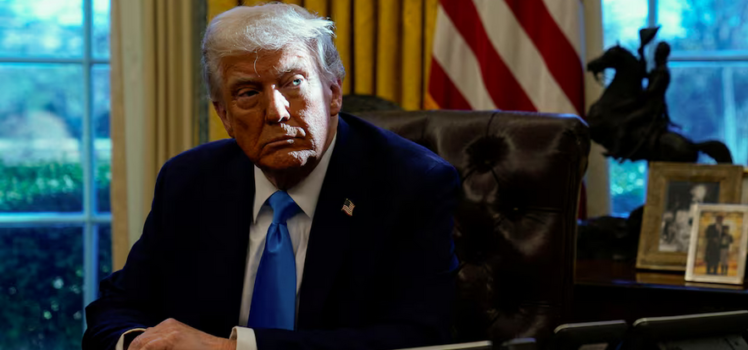
Trump said he might increase tariffs on China further unless Beijing stemmed the flow of fentanyl, a deadly opioid, into the United States.
China has called fentanyl America’s problem and said it would challenge the tariffs at the World Trade Organization and take other countermeasures, while
leaving the door open for talks.
The United States is a relatively small source of crude oil for China, accounting for 1.7% of its imports last year, worth about $6 billion. Just over 5% of China’s LNG imports come from the United States.
“Even if the two countries (the United States and China) can agree on some issues, it is possible to see tariffs being used as a recurrent tool, which can be a key source of market volatility this year,” said Gary Ng, senior economist at Natixis in Hong Kong.
There was relief in Ottawa and Mexico City after Canadian Prime Minister Justin Trudeau and Mexican President Claudia Sheinbaum said they had agreed to bolster border enforcement, pausing for 30 days 25% U.S. tariffs due to take effect on Tuesday.
EU trade chief
Maros Sefcovic said he wanted early talks with the United States to ward off potential tariffs.
“We believe through constructive engagement and discussion we can resolve this problem,” he said.
The Reuters Daily Briefing newsletter provides all the news you need to start your day. Sign up here.
Reporting by David Alire Garcia, Stefanie Eschenbacher and Brendan O’Boyle in Mexico City; Andrea Shalal, Jarrett Renshaw, David Lawder, Trevor Hunnicutt, Nandita Bose, Daphne Psaledakis, Douglas Gillison, Doina Chiacu and Susan Heavey in Washington; David Ljunggren and Promit Mukherjee in Ottawa; Ed White in Winnipeg; Kevin Krolicki and Qiaoyi Li in Beijing; Josephine Mason in London; Bart H. Meijer, Alessandro Parodi, Charlotte Van Campenhout, Andrew Gray, Sudip Kar-Gupta and Geert De Clerq in Europe; Aishwarya Venugopal in Bengaluru; Writing by Andy Sullivan and Lincoln Feast; Editing by Shri Navaratnam, Sharon Singleton, Timothy Heritage, Ros Russell, Mark Porter, Rod Nickel and Deepa Babington