What does China’s first Arctic coastguard patrol with Russia reveal about its ambitions?
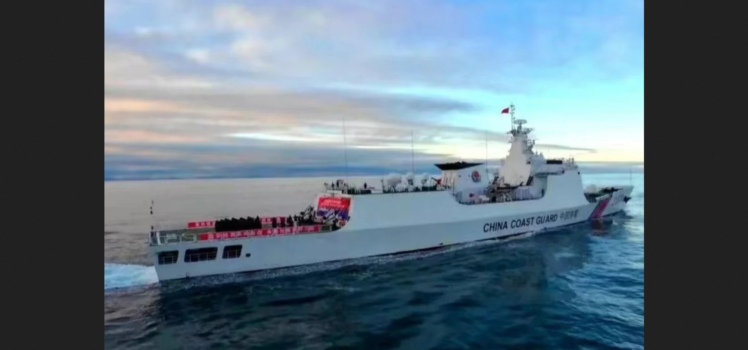
China’s state broadcaster CCTV on Wednesday released photos and footage of the exercise.
Four ships – including the Chinese vessels Meishan and Xiushan – had travelled to the Arctic from the north Pacific, CCTV said, in what was the first joint coastguard exercise between the two countries.
The United States Coast Guard said it spotted four vessels from the Russian and Chinese coastguards carrying out a joint patrol on Saturday in the Bering Sea, which separates Alaska from Russia. It said the ships were transiting around 8km (5 miles) within the Russian exclusive economic zone, heading northeast.
This marked the northernmost location where Chinese coastguard vessels had been observed, according to the US Coast Guard, which sent its aircraft to monitor the ships near St Lawrence Island between Russia and Alaska.
Its activities in the Arctic Sea suggest that the maritime law enforcement agency’s scope of operation may not only be limited to nearby shores, but may also extend to other international waterways where China tries to register its presence.
Isaac Kardon, a senior fellow for China studies at the Carnegie Endowment for International Peace, said the Chinese coastguard was “operating in line with the central leadership’s clear ambition to establish China as an Arctic power”.
He said while it was not likely that China’s coastguard would sustain a regular deployment in the Arctic in the near-term, this was likely to be the first of a series of periodic joint operations with Russian forces.
“The inclusion of CCG patrols is of a piece. There is almost certainly no genuine law enforcement mission here, but perhaps the beginnings of China securing long-sought Russian permissions to operate more extensively in the Arctic and eventually gain greater access to its emerging shipping corridor and vast resources,” Kardon said.
The Chinese coastguard has emerged as one of the world’s largest maritime law enforcement agencies in the world since it was transferred in 2018 from the civilian State Oceanic Administration to the People’s Armed Police – which reports to the Central Military Commission – and was given a number of modified decommissioned warships from the Chinese navy.
While the exact strength of China’s coastguard is not known, a Pentagon report published last year said the it had more than 150 regional and oceangoing patrol vessels weighing more than 1,000 tonnes, including more than 20 corvettes transferred from the navy, some equipped with helicopter facilities, high-capacity water cannons, multiple interceptor boats and guns.
The newer vessels transferred to the coastguard are designed to operate further offshore and remain on station longer than the older models, according to the Pentagon.
Timothy Heath, a senior international defence researcher at the US-based think tank Rand Corporation, said China chose to send its coastguard instead of its navy because law enforcement ships were “less provocative than military vessels” when operating in politically sensitive areas.
“In this case, both Russia and the US are sensitive to China’s presence in the Arctic. But the CCG operated under the mission of fisheries enforcement in the ‘North Pacific’ which provides the reason for CCG involvement,” Heath said.
“The choice of a CCG ship also signals China’s interest in shaping international governance practices and institutions.”
Liselotte Odgaard, a senior fellow at the Hudson Institute, a Washington-based think tank, said through the coastguard’s activities in the Arctic, China was signalling it supported “Russia’s patrolling rights” and also demonstrating “their ability to operate across the Arctic”.
“It is a way of showing that China is a near-Arctic state and that China intends to pursue what it sees as its legitimate rights to operate in the Arctic region, including the part far from the Chinese mainland,” Odgaard said.
“All this activity contributes to an enhanced Chinese presence in the Arctic, which is a dual-use presence and hence adds concerns for the Arctic Nato member states about strengthened Russian-Chinese cooperation in the region.”
The Arctic region has gained attention for its strategic importance, not only as a flashpoint between the US and Russia but also as a marine link between the Asia-Pacific region and Europe as climate change melts Arctic ice.
Since China issued a white paper on the Arctic in 2018, the country has described itself as a “near-Arctic state”. It has also increased its activities in the far north as it seeks an alternative shipping route to Europe to cut dependence on the Strait of Malacca in Southeast Asia, which has a considerable US Navy presence carrying out anti-piracy operations.
In July, the US Coast Guard spotted three Chinese military vessels about 200km north of the Amchitka Pass at the southwestern reaches of the Aleutian Islands, Alaska, and a fourth ship about 135km north of the Amukta Pass in the same islands.
Last month, Chinese and Russian militaries conducted joint drills in the Sea of Japan and the Sea of Okhotsk – two of the major shipping routes on the way from the Chinese coast to the Arctic. The two navies also patrolled in the northern Pacific Ocean.
Marc Lanteigne, a professor of political science at the Arctic University of Norway in Tromso, said there were “strategic implications” to the joint patrol between Chinese and Russian coastguards.
“[This included] underscoring the interests of both powers to cooperate more closely in Arctic maritime affairs,” he said.
Lanteigne said the coastguard activities were part of efforts to establish and develop its interests in expanding presence and economic activities in the Arctic.
“Beijing has repeatedly stressed that non-Arctic states have the right to engage in civilian operations in the Arctic, including maritime transits, and has referred to the central Arctic as a ‘common heritage’ of humanity.”
In response to increasing Chinese presence in the Arctic, the Pentagon updated its strategy for the region in July to strengthen its Arctic technological capabilities against China, which it described as a “pacing challenge” that “seeks increasing access and influence in the Arctic”.
Beijing includes the Arctic in “its long-term planning and seeks to increase its influence and activities in the region,” according to Washington’s renewed Arctic strategy report.
Odgaard said China’s activities in the Arctic were likely to strengthen cooperation between the coastguards and other capabilities of Arctic Nato members such as the US, Canada, Norway and Denmark.
According to Kardon at Carnegie, “One more permanent mission that might evolve over time could be to monitor the Chinese distant water fishing fleet if it begins to operate at scale in the Arctic, as well as tasks associated with keeping shipping routes open and secure if and when the Northern Sea Route becomes a major commercial thoroughfare for Chinese trade with Russia and Europe.”