
China’s Betting Nearly $48 Billion on Renewed Chip Tech Plan
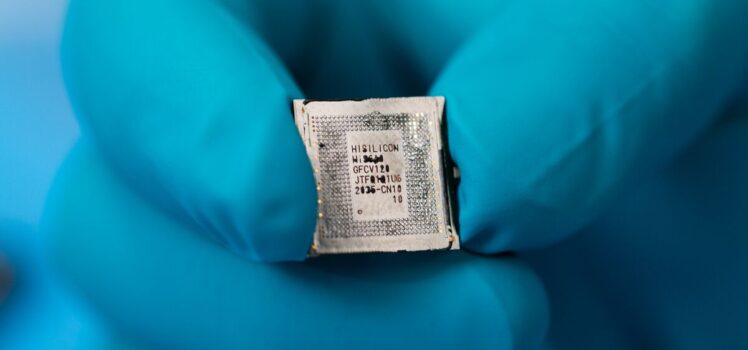
China has set up a $47.5 billion semiconductor investment fund as it renews its pursuit of self-reliance in the age of artificial intelligence. But first…
Reading the hints
China’s flagship National Integrated Circuit Industry Investment Fund (aka the Big Fund) just created the largest-ever chip investment vehicle in the country. The goal? To develop a standalone supply chain that’s impervious to US trade curbs.
It’s a strategically vital goal for President Xi Jinping’s government. government. China’s watching the rest of the world securing top-notch American silicon, such as Nvidia Corp.’s H100 GPU, that it has no access to. The new Big Fund III seems aimed squarely at ensuring China has the resources to develop and build AI-capable semiconductors without outside help.
China’s advantage is that it can throw all possible forms of support into the mix. The financial ones include direct investments and tax breaks for the most promising chip companies in the country. But it can also leverage the powers of a managed economy that are beyond the reach of rivals like the US. Read about the way it made Huawei Technologies Co. a national chip champion to get an idea.
Prior to this record-breaking fund, the country incorporated two similar vehicles in the past decade or so with a combined investment of roughly 300 billion yuan ($41 billion). That speaks to how much more expensive chip development has gotten, but the approach is also more targeted now.
Many local government funds like Chengdu, Chongqing and Wuhan chipped in previously. In Big Fund III, however, only Beijing, Shanghai and Guangdong have pledged investment, according to company registration information. In other words, they’re the chosen ones.
I read this as a sign that the former nationwide competition among expensive chip projects has come to an end. Beijing, Shanghai and Shenzhen in Guangdong province each has a particular focus and strength in the chip realm. In general, Shenzhen has expertise in chip fabrication, Shanghai is a manufacturing and equipment hub, and Beijing focuses on chip design.
China may pivot further to top-down project management to rectify problems of the past. Previously, Beijing hoped that the imprimatur of the Big Fund would entice private-sector investment — which flourished briefly, but quickly petered out. Instead, disorganized distribution of funds yielded overcapacity. Oh, and a whole graft investigation into how the funds were directed.
With little venture capital appetite for China right now, Beijing has to take a bigger role in funding the biggest projects, such as those by Semiconductor Manufacturing International Corp. and other newly built fabs that work closely with Huawei. The prominent role of state-owned banks in Big Fund III, from China Development Bank to Industrial & Commercial Bank of China, also indicates the importance of state capital in Chinese chip plans.
Much of the funding will have to go toward advanced chipmaking, which is both capital-intensive and extremely competitive. China has identified high-bandwidth memory as an area to invest in, according to a state newspaper report this week, and that makes sense since HBM is an essential component of the best AI accelerators. But this task is not an easy one. Even Samsung Electronics Co. has fallen behind — to compatriot SK Hynix Inc., which has poured many years of investment into developing the technology.
The job of building a standalone supply chain is an even more complex endeavor. It demands investment in every area from chip design software to alternative tooling and machinery. A good number of these essential ingredients are made or designed by the US or its allies such as the Netherlands and Japan. China will have to invent its way out of that conundrum.
And all this is happening while the AI race heats up. Though at least one Chinese AI player is still optimistic.
SenseTime Group Inc. co-founder Xu Bing told Bloomberg News that China, and Asia more broadly, will eventually close the gap on the US. Sure, China doesn’t today have the computational resources of its geopolitical rival, but that won’t be permanent.
“Compute is a commodity,” Xu said. “In the long run, compute won’t be a gap.”


