China’s Stalling Economy Puts the World on Notice
As China’s economy flashes indications of decline, the consequences pose perils for countries around the globe.
For more than a quarter-century, China has been synonymous with relentless development and upward mobility. As its 1.4 billion people gained an appetite for the wares of the world — Hollywood movies, South Korean electronics, iron ore mined in Australia — the global economy was propelled by a seemingly inexhaustible engine.
Now that engine is sputtering, posing alarming risks for Chinese households and economies around the planet. Long the centerpiece of a profit-enhancing version of globalization, China has devolved into the ultimate wild card in a moment of extraordinary uncertainty for the world’s economy.
The risks have been amplified in recent weeks by a slew of developments.
First came word that China’s economy had slowed substantially in the spring, extinguishing hopes of a robust expansion after the lifting of extreme Covid restrictions.
This week brought data showing that China’s exports have declined for three months in a row, while imports have dropped for five consecutive months — another indicator of flagging prospects.
Then came news that prices have fallen on a range of goods, from food to apartments, raising the specter that China could be on the brink of so-called deflation, or sustained drops in prices, a harbinger of anemic commercial activity.
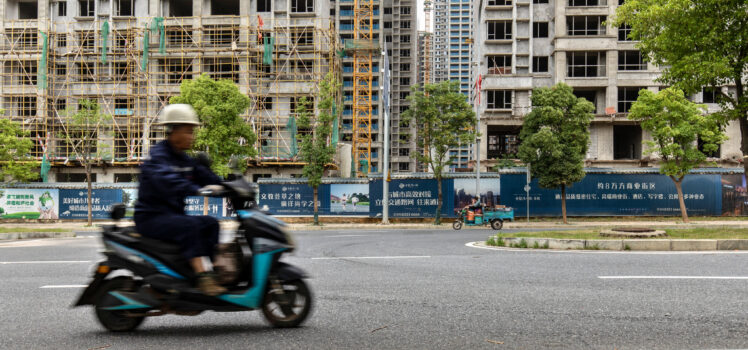
And in a sign of deepening distress in China’s housing market — the intersection of finance, construction and household wealth — a major real estate developer, Country Garden, missed payments on its bonds and estimated it lost up to $7.6 billion in the first half of the year.
For Chinese workers and households, these events added up to trouble. Around the globe, a weakening Chinese economy signaled a shrinking of demand for major goods — from soybeans harvested in Brazil, to beef raised in the United States, to luxury goods made in Italy. It spelled less appetite for oil, minerals and other building blocks of industry.

“The slowdown in China is definitely going to weigh on the global economic outlook,” said Larry Hu, Hong Kong-based chief China economist for Macquarie, the Australian financial services firm. “Because China is now the No. 1 commodity consumer in the world, the impact is going to be pretty, pretty big.”
Over the past decade, China has been the source of more than 40 percent of global economic growth, compared with 22 percent from the United States and 9 percent from the 20 countries that use the euro currency, according to recent analysis from BCA Research.