Analysis: Putin promises Xi to ‘fight for five years’ in Ukraine

Meant to keep China on Russia’s side, the words in March prompted Beijing to hedge its bets
Katsuji Nakazawa is a Tokyo-based senior staff and editorial writer at Nikkei. He spent seven years in China as a correspondent and later as China bureau chief. He was the 2014 recipient of the Vaughn-Ueda International Journalist prize.
During a meeting in Moscow back in March, Russian President Vladimir Putin told his Chinese counterpart Xi Jinping that Russia “will fight for [at least] five years” in Ukraine, sources have revealed.
This was apparently Putin’s way of summarizing a situation that at the time was not favorable to Russia and assuring Xi that Russia would emerge victorious in the end.
The likely implication was that a protracted war would favor China’s well-armed partner.
Taken another way, the remark was also a warning to Xi not to change his pro-Russia stance.
The trip was Xi’s first to Russia after Moscow launched a full-scale invasion of Ukraine in February 2022. It was also the first time Xi visited a leading nation after China lifted its strict zero-COIVD policy.
Whether Xi was convinced, Putin’s remark at the summit holds the key to understanding a series of mysterious developments in Russia-China relations, from a Chinese peace mission to Europe in May to China sacking its foreign minister months later.
 It was at The Grand Kremlin Palace in Moscow on March 21 that Vladimir Putin mentioned to Xi Jinping that Russia’s war in Ukraine would last for at least “five years.” © AP
 Recently, The New York Times reported that since at least September Putin has been using intermediaries to signal that he is open to a cease-fire on condition that Russia can keep the territories it now occupies.
But given Putin’s words to Xi in March, revealed by multiple sources familiar with diplomatic maneuvering between China and Russia, the Russian leader’s reported intentions for a cease-fire should not be taken at face value.
It could be that Putin wishes to merely create the illusion that he is moving toward a cease-fire or even peace ahead of Russia’s presidential election in March, believing such an atmosphere would favor him at the polls.
 Putin submits candidate registration documents for Russia’s upcoming presidential election, at the Central Election Commission in Moscow on Dec. 18. © Reuters
 Meanwhile, Xi’s China has revisited its strategy, partly based on Putin’s “five years” remark in March.
If the war between Russia and Ukraine grows more prolonged, it would significantly impact plans and ambitions Xi has for his unprecedented third term as China’s president and Chinese Communist Party general secretary. Xi’s big goal of unifying Taiwan with mainland China could also be affected.
But it is unlikely Xi was fully convinced by Putin’s remark. Xi already holds a grudge against Putin dating back to a China-Russia summit held Feb. 4, 2022, the opening day of the 2022 Beijing Winter Olympics.
Putin was the only leader from a major power to attend the opening ceremony, and Xi had staked his reputation on China successfully hosting the international sporting extravaganza. The Russian leader fully took advantage of China’s sense of indebtedness to him.
During the Winter Olympics summit, Putin showed no sign he was about to launch a full-scale invasion of Ukraine. But that invasion did come, on Feb. 24, with a blitz Russia believed would be powerful enough to conquer the Ukrainian government in Kyiv, that country’s capital.
 Putin and Xi strike up their no-limits partnership in Beijing on Feb. 4, 2022. © Reuters
 The surprise attack left China panicked.
At their talks 20 days earlier, Xi and Putin had declared a “no limits” partnership between their countries. Therefore, it was quite natural for people around the world to conclude China had given a tacit nod to Russia’s full-scale invasion.
But that was not the case. China had misjudged Russia’s true intentions.
Beijing, which surely knew Russian forces were massing near the border with Ukraine, must have concluded those troops would only invade the eastern part of Ukraine.
At any rate, Xi’s administration was not expecting a full-scale invasion, especially one that would take place only four days after the closing of the Beijing Winter Olympics and a week before the opening of the Paralympics Winter Games, supposedly a festival of peace.
Thus, China simply could not afford to completely trust Putin’s ‘will fight for five years’ remark that came a year later.
Given the complicated international political situation, China needed to think about how to protect its own interests regardless of how things might end for Russia in Ukraine.
And that meant sending a “peace mission” to Europe, including Ukraine and Russia, less than two months after Putin told Xi Russia would remain in the fight for years to come. The mission demonstrated a subtle shift in Xi’s pro-Russia stance.
 This satellite image shows a convoy of Russian ground forces some 60 kilometers from Kyiv on Feb. 27, 2022. © 2022 Maxar Technologies
 It was also in line with Xi’s oft-repeated words that “profound changes unseen in a century” are currently taking place in the world.
If the Ukraine war were to drag on for as long as five years — it has already lasted nearly two years — China would come under more pressure than ever from Western nations due to its wide-ranging military cooperation with Russia.
China’s already suffering economy would take further blows from measures imposed by the international coalition against China and Russia. This gave China another reason to send that peace mission: It would need to hedge its bets so as not to share Russia’s fate.
The Chinese mission, led by Li Hui, Beijing’s special representative for Eurasian affairs, met with Ukrainian President Volodymyr Zelenskyy in Kyiv.
Of course the mission made Putin unhappy, perhaps even angry. The diplomatic move went against the Russian leader’s wishes and showed that China had discarded his “five years” remark.
To make matters worse, less than a month later, in June, Wagner, the Russian private military organization led by Yevgeny Prigozhin, who held the key to fighting in Ukraine, launched a short-lived rebellion, giving Putin a close call.
To Putin, who suddenly needed to weather an increasingly violent storm, keeping China in Russia’s camp was a pressing matter. So he came forward with some information.
When Russian Deputy Foreign Minister Andrei Rudenko visited Beijing on June 25, he tipped off senior Chinese officials about then Chinese Foreign Minister Qin Gang. The tip was related to the mystery of Qin’s sudden purge, as reported here in detail two weeks ago.
Deception is an oft-used tactic in international politics. And the fact that China and Russia are both ultra-secretive makes understanding each other’s affairs even more difficult. Common sense does not apply.
Putin’s remark to fight for five years in Ukraine might also affect Japan’s military policy.
In a significant shift, Japan has already revised basic principles that for years banned arms exports.
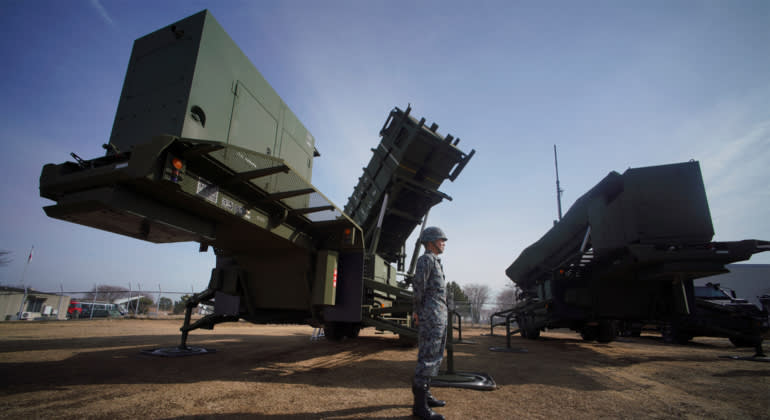 A member of the Japan Ground Self-Defense Force stands guard next to a surface-to-air Patriot Advanced Capability-3 missile interceptor launcher vehicle in Funabashi, east of Tokyo. © AP
 Based on the recent revisions, the government decided to export Patriot surface-to-air guided missiles manufactured under a license in Japan to the U.S. The U.S. has been supplying Patriot missiles to Ukraine and surrounding countries.
Japan will export Patriot missiles to the U.S. on condition they not be supplied to third countries. Still, the main purpose is to complement the U.S. stock of missiles as America’s inventory is running low due to Russia’s prolonged invasion of Ukraine.
If Russia’s invasion of Ukraine were to continue for five years, Japan could come under pressure to further change its thinking on arms exports. This is an issue that will also affect various affairs involving the Taiwan issue.
Xi’s China has not ruled out the use of force to unify Taiwan.
It is important to keep in mind that conversations between the Chinese and Russian leaders in 2023, especially Putin’s March remark about prolonging the Ukraine war, can have ramifications on the security of Japan and the entire Indo-Pacific region.