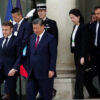
The downfall of Zhang and Liu marks the most high-profile firings since Xi launched a sweeping purge of China’s military in 2023, beginning with the senior leadership of the elite Rocket Force and expanding to the air force, navy and army, eventually sweeping up the defense minister and scores of other officers and defense-industry figures.
Xi has left many of those positions vacant. The latest rupture leaves the CMC — China’s top military decision-making body, staffed by Xi in 2022 with six senior generals — reduced to just one member besides the leader himself.
After the purge in March of Gen. He Weidong, Zhang became the CMC’s sole vice chairman, overseeing 15 departments and commissions responsible for key military decisions and 2 million troops. Previously, he served as head of the General Armaments Department, a powerful body overseeing weapons procurement contracts and a longtime focal point for corruption investigations.
Analysts say earlier purges may have helped set the stage for Zhang’s downfall by concentrating too much power in the hands of the senior general. “I don’t think Xi Jinping was comfortable with how much power Zhang Youxia had accumulated in this process. And maybe Zhang, internally, wasn’t exactly deferential,” said Dennis Wilder, a former CIA China analyst and now a senior fellow for the Initiative for U.S.-China Dialogue on Global Issues at Georgetown University.
It remains unclear whether Xi will move to replace Zhang, Liu or other senior officers stripped of their ranks. The timing of the announcements — just ahead of the Lunar New Year holiday, when formal political activity largely pauses — further clouds the succession picture. The only remaining CMC member is Zhang Shengmin, who is head of the military’s anti-graft watchdog that has overseen the sweeping purges.
The extreme concentration of military power under Xi also narrows the circle of decision-makers overseeing Taiwan and other critical matters, including control of China’s vast nuclear arsenal.
Analysts say older-generation PLA leaders have historically served as a moderating force within military decision-making. “I think these old guards are much more reluctant to attack Taiwan,” said Sun of the Stimson Center. “Xi wants his own people; he wants younger people that will, in a way, be more beholden to him.”
The reshuffling of China’s military leadership comes as Xi pushes to rapidly modernize the armed forces and meet major benchmarks, including a stated goal of achieving the capability to invade Taiwan by 2027. Late last month, Beijing staged an unprecedentedly large military exercise encircling the self-governed island, a show of force that used live-fire missiles and simulated a near-total blockade of Taiwan.
The developments also come amid fast-changing dynamics in the U.S.-China relationship, as President Donald Trump plans to visit China later this year. Last month, he brushed off concerns about the Taiwan exercise — widely interpreted as Beijing’s response to a $11 billion U.S. arms package for Taipei — by saying he had “a great relationship with President Xi.”
The purges could, however, give Trump a modicum of leverage in future talks, analysts say, even as Beijing projects confidence amid widening rifts between the U.S. and Europe over Greenland. “Xi is going to want to show that everything’s normal, that he’s in charge. He wouldn’t want a disruptive visit,” Wilder said.
China’s military and political leadership structure is among the world’s most opaque, leaving the full impact of the purges unclear. In an annual report released in December, the Pentagon said the sweeping personnel changes likely “caused uncertainty over organizational priorities and lack of continuity,” but said the streamlining has “the potential to improve PLA readiness in the long term.”
Beyond the military, China is carrying out a record-breaking disciplinary purge across the government, punishing over 980,000 officials last year, according to official statistics — the highest total since authorities began publishing such figures in the early 2000s.
Officials punished under such disciplinary rules are rarely exonerated and can face allegations ranging from negligence to graft, with penalties spanning mandated political education to, in the most serious cases, execution.